A friend of mine ran his first marathon last fall.
He set the goal of successfully finishing the race almost two years earlier. He started with 5k races. I know the first few were more walking than running, as my friend was not an experienced runner, and had been a smoker for several years.
From 5ks, he went to 10ks and then two half marathons before tackling the final goal. When I asked why he started preparing so far in advance, he said his goals were to finish, finish with what he felt was a reasonable time, and to come away without any injuries.
He told me a big key to “no injuries” was to make sure he wore shoes that were broken in a bit. Definitely not right out of the box. That would be a recipe for blisters and disaster.
In a few months, we’re heading to a favorite destination in Arizona. In March, the Arizona weather is a nice break from the Midwest and I get to take in a Cubs spring training game or two.
Also when we visit, I make it a point to hike a few mountain trails, most notably Camelback Mountain. It’s not very difficult and many people do it, but I’ve made it a goal to hike it as long as possible, making it to the top and back down.
It is not a difficult hike, but I would definitely have trouble making the trek after four months of inactivity and hibernation in a Chicago winter. So a few weeks ago I began my preparation, working out alternately on a stationary bike, a treadmill and a StairMaster.
After all, I want to be able to hike up and down the mountain before the heat of the day sets in, without pulling a muscle or worse yet, falling and breaking something. And while it is nothing like running a marathon, for me, it definitely requires preparation. Oh, and I’m breaking in new hiking boots too.
Planning for a trade show is really no different than preparing for a long run or a strenuous climb. You can’t just show up and do it. Ok, yes you can just show up without much planning, but your chances for success are definitely reduced. There’s also the increased likelihood of a few more stumbles along the way.
Instead of hitting the treadmill, trade show veterans recommend the following pre-event timeline:
6 Months - 1 Year until Show Time
Look at what shows are on your schedule, or new shows where you may want to exhibit. Budget accordingly and book your space.
3 - 5 Months until Show Time
Dig into the exhibitor manual. Establish goals and objectives. Will you be using existing properties, purchasing new or renting? Talk with your display and graphics partner so everyone is on the same page.
2 - 3 Months until Show Time
What types of collateral material will you be sending? What other services will be needed-AV, special electrical requirements, shipping, etc.?
1 - 2 Months until Show Time
Order show services and get your EAC forms submitted. Discount deadlines are usually within this timeframe. Meet/talk with your supplier partners to make sure you have correct arrival dates and addresses, and everything else is on schedule.
2 Weeks until Show Time
Confirm, confirm and confirm. Make sure all show services are in order and everyone involved knows what is expected of them.
1 Week until Show Time
Buy new shoes and break them in. Show floors are hard on your feet!
Just like a marathon.
Steve Moskal
In January, I will be celebrating 34 years of being involved in the trade show industry. Yep, in January of 1983, I was introduced to the Nomadic Instand. The Instand, according to Exhibitor Magazine was one of the "10 Ideas That Changed the Trade Show Industry".
If I would’ve known 34 years later I would still be involved with that same product, along with a library of different types of useful tools and services, I would’ve committed myself, right then and there.
I have always loved what I do. I loved my customers and making them happy. After all, Prairie would not be here without them. Sure, there were and still are, bumps, blips and challenges - what industry or line of work doesn’t? Maybe the challenge is what keeps me coming back every day. That, and the fact that my wife would’ve kicked me out of the house years ago.
I also enjoy sharing what I’ve learned, especially with those who are new to the business, on the industry or client side. When I step back and begin to appreciate the practical knowledge gained over the years, it’s like being an expert safe-cracker who relies on his experience and gut feeling to break the combination.
Given enough information, time, a dedicated internal team and a carefully selected group of vendor/partners, I feel anything, within reason, can be accomplished.
Best practices are important too. They are important for staying the course and being your best. Take what I have written below, for what they are: habits, actions and behaviors that just seem to make sense.
-Get to your desk or work space early. It’s amazing how much you can get done before everyone else comes in, the phone starts ringing or the emails are flying. My father had an amazing work ethic. He instilled that in me.
-Have a client meeting? Be at least 5 minutes early. If you’re actually earlier, stop in at a neighboring business to drop off your business card. I found a valuable, long-time customer this way.
-Have a mentor. Find someone who has been doing what you do, but longer. Talk to or email them frequently. Ask their opinion of what they would do in certain situations. My mentor has been gone a number of years now. I still remember some of the great advice he sent my way. Being 5 minutes early was one. He actually had his watch set ahead 5 minutes. He called it “sales time”.
-Join and be active in two professional organizations. Interaction with existing or potential customers should be the focus of one organization, while the other should be one that helps you expand your skills and knowledge of your industry and profession. A LinkedIn group doesn’t count as a professional organization.
-Have a hobby. Do something for pure enjoyment that has nothing to do with what you do on a daily basis. You don’t have to do it every day, but try to do it as often as you can.
-Make time for family and friends. If you don’t, your family will start to forget who you are and the number of friends will start to dwindle. Maybe if you come in early, you don’t have to stay late? Look at your calendar. Make dates with your wife/significant other in advance. Most importantly, keep them.
-Take a class. Your local community college has some great continuing education or adult enrichment classes. Subjects are varied, the tuition is affordable and best of all, you don’t have to worry about grades. My mentor was the one who reminded me that learning should be a lifelong pursuit.
-Walk, when you can. We are fortunate enough to live in a town where I can easily walk a few blocks to a store, restaurant or post office. If you do need to drive to your destination, park a little farther than you think you need to. Every step counts.
-Smile. Laugh, too. As much as you can.
There are many others, but here is one I learned a few weeks ago.
At a Toastmasters training session, a presenter made this statement about “excuses”:
“Excuses are the tools of incompetents that build monuments to nothingness and those that use them seldom accomplish anything.”
This quote has been attributed to many famous people, including Benjamin Franklin. She said it several times during her presentation to drive the point home.
“Excuses are the tools of incompetents that build monuments to nothingness and those that use them seldom accomplish anything.”
Something to think about the next time you hit a bump, blip or challenge.
I know I’ve made my share of excuses over the past 34 years but I don’t see any monuments around, so I must have kept them to a minimum.
Here’s to an exciting, busy and challenging 2017. No excuses here.
Steve Moskal
There will never be a shortage of advice, paid or free, when it comes to managing a successful trade show program. Go ahead, Google it or go to your choice of exhibit industry social media groups.
They are all there: ship to advance warehouse, take advantage of discount deadlines for ordering show services and audio visual, get the better carpet padding, bring extra extension cords, wear comfortable shoes, blah, blah, blah, and on and on.
Don’t get me wrong, they’re all good, usable snippets of information and direction. To the experienced pros who post these on Facebook, and repost and like on LinkedIn, thank you. Don’t let it ever be said that our industry doesn’t put it all out there. Everyone has a story, a “plan b” scenario or experience to share.
Probably one of the most comprehensive books I have ever read is Show and Sell by Margit Weisgal, longtime industry professional and past president of the sorely missed Trade Show Exhibitors Association (TSEA). It’s still available on Amazon. Or, get in touch with Margit (margit@margitweisgal.com), she might be able to get you a copy. It’s worth a read and handy to have around. Tell her I sent you!
Where is all this going? Well, to a few more pieces of advice!
We found ourselves a little short-handed in our display inspection and prep department last month, during a very busy fall show season. Hiring a new associate in the middle of show season would be like handing the ball to a fan in the stands when your professional baseball team has run out of pitchers. This was also not a time for on-the-job training.
If anyone has ever run a company or organization, you jump in where and when you can. I volunteered to come in after hours and help get us up to speed on inspections. Inspections include checking, cleaning and repacking display properties when they come back from a show or event. It also includes getting them ready for the next use, making any repairs, adjustments or additions, as needed.
Performing inspections was a great reminder to me that, just like your car, in order for your display properties to function properly, you have to check the oil, rotate the tires and make sure the windshield wiper fluid is full. If not, you’re destined for a breakdown and will be unprepared when it happens.
So based on getting my hands dirty and my back stiff, while inspecting several 10’ and 20’ inline displays:
1. Always, always, always, check your display properties when they come back from one show, before they head out to the next.
2. Make sure to remove all old shipping and show-related labels from cases and crates.
I know, I know - time is tight, there is no one to do it, there isn’t enough space. There are plenty of excuses not to complete an inspection. But when the best fix for repairing a ripped graphic on the show floor is carpet tape, and you have to beg the general contractor to let you pay $100 to rent a 15’ extension cord, maybe it’s time to find the time or the right people to do it. I mean, it is perfectly understandable that everything doesn’t come back the way it was sent out. It’s just a simple fact.
I cringed when I saw a newspaper photo of a logo table throw that was used during a pre-election debate between Illinois’ two Senate candidates. Doesn’t anyone know how to iron anymore? Is that the impression you want to make to your customers and other attendees - that you’re wrinkled and unprepared?
A word about shipping labels. Here are a set of cases that came back from a recent event - yes, just one event. There are outbound labels covered by inbound labels and routing stickers. If you reshipped these cases and just slapped a label over one of the old labels, who knows where the display would end up if the labels fell off.
My advice: take the time to thoroughly inspect and maintain your properties after each event. After all, you want everything to be in its place and looking the best it can, and you want it delivered to the right place.
If you need the name of a great spray solvent that takes off gummy labels like melted butter, just let me know.
And don’t forget the comfortable shoes. Feel free to repost or like, folks.
Steve Moskal
Three things I learned this week:
Penny candy is now a dime;
The Waze app might be too good;
Shipping is not cheap anymore.
Yes, I remember penny candy. Penny candy was a tradition in the 1960s. This was a time when there were different shopping patterns. Mom and pop stores and general stores were common in the neighborhoods. They sold everything from newspapers to milk, and birthday cards to bread. And yes, there was candy sold at a penny or two apiece.
I was in one of those trendy “nostalgic candy stores” the other day. You could fill a bag with Bazooka Joe bubble gum, mini pixie sticks and Smarties all for a per pound price. I filled a bag, and once weighed and priced, it worked out to about 10 cents per piece. When I informed the young girl behind the iPad cash drawer that the sign read “penny candy” not “dime candy”, all I got back was a puzzled look.
Bazooka Joe tasted the same. Chalky, hard and bland, and still came with a bad comic. Will someone please explain why it is acceptable for a 13 year-old kid to have an eye patch?
The Waze app is great. I downloaded it a few months ago. Waze gave me a new shortcut to Wrigley Field, taking me down streets I never knew existed. What would normally be an hour and a half endeavor at rush hour was shortened to less than an hour. I pulled up to my friend’s condo just north of Wrigley at the exact time Waze said I would.
Driving through northern Indiana, heading to Chicago on a Sunday evening can either be a breeze or traffic nightmare. Last weekend, Waze had me take a little used exit to avoid an anticipated delay. Ha! Got this one beat, I thought.
Cruising along for a few miles, taking unusual turns and twists, Shelley asked, “Where on God’s green earth are we going?”. Guided to the last turn, I encountered a three block long line for the left turn lane. It appeared that every other Wazer was taking the same route. There was now a major delay because of a major delay. Is there an app for getting around that?
A customer called me the other day to ask why shipping was so much for a certain project. She told me the line item from the invoice and what was shipped. My first response was, “Yea, something has to be wrong here. This should be more like $50, not $180.”
So I asked my shipping folks. “Nope,” they assured, “that was the cost.” I asked for the dimensions, weight and shipping destination. “Check it for yourself,” they told me.
I logged into the UPS site and entered the data. Yikes! There it was, $180! And that was for ground shipping. Where did I come up with $50?
I pulled similar jobs from 2011 and 2007. The answer was right there. My unrealistic view of today’s realities came to an abrupt end. In 2011, the cost was $83 and in 2007, it was $55. These were the costs to ship the same size and weight case, a similar distance. I simply had been living in the past.
Shipping costs have gone up considerably over the past few years. Taking a look at what you are shipping has never been more important to the bottom line of your exhibit program. Sending fewer boxes of literature or using fabric for graphics instead of oversized rigid panels are just a few of the ways to reduce not only the weight, but also the dimensions, of your shipment.
After all, there really isn’t anything such as penny candy anymore and Waze has done an admirable job of taking the guesswork out of determining the best route to take. The only downside would be if all 50 million Waze users took the same country road, at the same time.
As far as the cost for getting display properties from point A to point B, anything larger than a piece of bubble gum, is getting more and more expensive to move. Time to get out of 2007.
Even Bazooka Joe and Mort look a bit different these days.
Steve Moskal
The legend lives on from the Chippewa on down
Of the big lake they called 'gitche gumee'
The lake, it is said, never gives up her dead
When the gales of November come early.
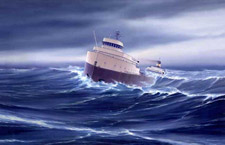
If you are like me, the lyrics of Gordon Lightfoot’s 1970s chilling ballad, “The Wreck of the Edmund Fitzgerald”, are etched in your brain. Maybe not word for word, but there’s a good chunk up there.
Lightfoot recounts the haunting story of a U.S. iron ore freighter that disappeared during a storm on Lake Superior, when the “witch of November came stealin’”.
The “gales/witch of November” are something to be expected every year around the same time on Lake Superior. The weather turns quickly and boaters and freighters know they have to get their last trip in before the winds hit. But the early north winds caught the Edmund Fitzgerald by a bit of a surprise and were not expected.
The Great Lakes (Superior, Michigan, Huron, Erie and Ontario) are the largest contiguous body of fresh water in the world. Yes, the world. If you emptied the water over North America, the water would be 5’ (1.5m) deep.
Quite a massive body of water. Lakes Michigan and Superior, especially, can be as calm as a lazy river one day and eat up freighters the next. I’ve seen it and felt it.
While kayaking on Lake Superior a few weeks ago, what started out as a calm and slightly overcast day eventually turned into a challenging paddle. We put the kayaks in and travelled a few hours up the coast of Grand Island outside Munising in Michigan’s Upper Peninsula. The weather turned and I had water coming over the front of my boat. A light, misty rain started to fall and the temperature dropped. I was quickly getting cold and wet.
Then these lyrics popped into my head, repeating over and over again...
The captain wired in he had water comin' in
And the good ship and crew was in peril
And later that night when his lights went outta sight
Came the wreck of the Edmund Fitzgerald
It was obvious that it was time to head back across the strait to shore. After all, I didn’t want the lights to get outta sight. We turned with our backs to the wind and cut across the strait, back to shore. We really made tracks.
The searches all say they'd have made Whitefish Bay
If they'd put fifteen more miles behind her
There is a time of year that we trade show professionals know is coming. It’s the trade shows of September.
Yep. It happens every year. The show season starts to ramp up toward the end of September and keeps everyone at Prairie on our toes until December. But as I got back into the saddle at 758 Industrial Drive on August 29, BAM! The phone started ringing and the emails were flying. It was the Trade Shows of September coming early!
Like the Great Lakes, July and August are a bit of a quiet time for the trade show and event industries. We know September is coming but we get a little lazy and lax. This is traditionally the time when we all take a break, use racked-up vacation time and just take a breath. Hey, we deserve it don’t we?
But it came a little bit early this year. I’m glad I made it back to port, just in time.
Superior, they said, never gives up her dead
When the gales of November come early
Steve Moskal
Water skiing.
Holding onto a big, half-filled, water balloon.
Herding cats.
These are examples of tasks that would seem fairly easy once they’ve been successfully completed a few times. The reality though, is just when you think you’ve mastered them...Splat! You fly off your skis and face plant into your own wake.
Trade show planning should be added to this list.
Let’s say you have a dozen or so shows under your belt. You can breeze through a show book in under an hour. Making sure the display properties are ready for the next event, you’ve trained your staff how to set up, take down and properly pack all cases. You even taught them how to turn in the outbound shipping documents at the end of the show.
Got it. Mastered! Sure you do.
Then the human interaction part of your exhibit life throws you some curve balls. Splat, once again. The water balloon slips from your grasp and soaks your new pair of Under Armour Curry Two shoes.
Here are a few human-thrown curve balls that our customers have experienced, just in the past few months:
The general contractor used an old address on the advance shipping labels included in the show book. The shipment is returned as “undeliverable”.
During dismantle, someone from the adjoining booth spilled coffee on the lights’ electrical connection, shorting out the transformer.
The carefully-trained rep working the show, needed to leave the show early for an emergency and relied on the new guy to hand in the outbound shipping forms. The forms went into a briefcase and didn’t see the light of day until two weeks later.
In all three of these instances, our clients were relying on a human being to correctly carry out what is expected. What are humans prone to do? Yes, you filled in the blank - make mistakes.
Fortunately, there were happy endings to each of these three potential disasters.
For the first situation, luckily the shipment (UPS) arrived back to our dock and there was still time to re-label and resend to the correct address.
The shorted transformer was discovered because the customer had Prairie inspect the properties after the event, while we updated the graphic. If the display shipped directly to another show, that would have been an issue. The customer decided to invest in a few extra transformers to include in their inventory. Good idea.
In the last instance, the customer was using a freight company that specializes in trade show shipments. The shipper had several other pick-ups at the event and caught the mistake before the freight would’ve been forced, or ended up at the general contractor’s warehouse. Additional hefty handling charges and the panic of a missing display, were avoided.
Sometimes, no matter how you plan, no matter how you install backups into your system, if one of the thousands of moving parts of a trade show does not perform the way you expect it to, you are ultimately responsible and will have to deal with the outcome. It’s a given. Remember, it’s that human factor.
So what do you do next time? Save the 180 degree swivel turn for a non-wavy day,
only play water balloon toss in bare feet or flip-flops and never, ever let the cats see you sweat and struggle. If you remain calm and poised, and don't let them know they’re being backed into a corner, they will fall right in line.
A little catnip helps in the process as well.
Best Regards,
Steve Moskal
The sales process - the steps of getting a customer to say yes - hasn’t changed much over the years.
I do feel though, that the mystical sales curtain has been pulled back in so many instances. Not only has the great wizard been exposed, but so has the puppy dog close and “Do you want it in red or green?”. Those who have been selling for more than a few years know what I am talking about.
These days, customers and prospects are much more informed about the business to business sales process. They understand how the process works, and can smell a bad close, like cheap cologne, a mile away. You won’t, and you shouldn’t try to, pull a fast one on anyone.
Trade shows continue to be an important part of the the sales process. Shows can represent the ever-important first step, or introduction. For customers or prospects you already know, meeting at a trade show can reestablish rapport with a discussion of needs, a demonstration and maybe a close! After all, this may be the only time this year you get a face-to-face meeting with your prospect (that’s a whole other blog).
European companies also value trade show opportunities. Trade shows, like fairs and exhibitions in Europe, are integral pieces of the sales puzzle.
Any similarities though, stop right there.
What’s different? Well, just about everything. The focus, number of days, hours, booth sizes, regulations, logistics, labor, culture and yes, the financial commitment.
The costs associated with exhibiting at a trade show in the United States can be two to three times the cost of similar space and amenities at a European venue.
It’s not like show organizers is trying to overcharge, it’s just the nature of the beast. I can’t really explain it any other way unless you’ve actually participated in a show. If I’ve had this conversation once, I’ve had it a hundred times. Really, that’s how much it will cost.
Countless articles have been published on comparative show costs, and there is no shortage of websites and LinkedIn groups dedicated to the subject. One of our exhibit partners has put together the most concise comparison I’ve seen to date. Click on this link to download a copy. It is truly worth the read.
Based on the conversations I’ve had over the years, the two biggest differences between exhibiting in the U.S. vs Europe are:
1. Logistics. The United States is big.... really big. More distance means higher costs to move people and properties from point A to point B. After driving from San Francisco to Chicago, a family friend from France stated, “It’s like driving from Paris to Moscow!”
New York to SanFrancisco: 2900 miles (4667 km)
Chicago to Orlando: 1200 miles (1931 km)
Atlanta to Las Vegas: 2000 miles (3218 km)
Seattle to New Orleans: 2600 miles (4184 km)
Washington DC to Dallas: 1400 miles (2253 km)
It even starts to freak me out when I look at the mileage. Those are long hauls!
2. Time and Focus. In the United States, show days (2-3 at most) and hours are fewer than European shows. In the U.S. most trade shows are associated with educational components like seminars and classes. Time is tight. Entertainment and extended conversations many times are carried out at functions before or after show hours.
The focus of show hours is more about gathering attendee’s information and establishing follow up requirements for after the event. There is little time to do much else. Instead of wining, dining and socializing in the booth/stand, as can be the focus at many European events, those functions are mostly accomplished outside show hours or off the show floor. So the four couches, six comfy chairs and open bar in a 20’ inline space might not cut it. There is just not enough time and space.
For explanation of the other differences, I invite you to download the pdf. And believe me, we’re not just making it all up.
My recommendation? Stick to the basics:
-Get Attention
-Engage
-Qualify
-Close (for the next step)
To all of our European friends, the sales process here is not that different, but the nature of trade shows and exhibitions is quite different. There is a popular saying that goes “When in Rome, do as the Romans”.
In the U.S., we have a similar adage: “When in Chicago/Las Vegas/Orlando/Atlanta, etc. do as show management, the venues, freight companies, labor, and mostly the customer, tell you”.
Pay no attention to that man behind the curtain. He just wants to know if you want delivery on Monday or Wednesday.
Happy exhibiting.
Steve Moskal